Clinical Foundation · Every Procedure
Tumescent Local Anesthesia
Every procedure at Zelko Aesthetics is performed under tumescent local anesthesia only, with no general anesthesia and no hospital. It numbs the treatment area completely, guests stay awake and comfortable, and they go home the same day.
The Foundation of Everything
Every procedure at Zelko Aesthetics is performed under tumescent local anesthesia only. No general anesthesia. No hospital. It is a clinical decision with specific, documented reasons, and this page lays them out.
What It Makes Possible
Tumescent anesthesia eliminates the risks of general anesthesia entirely while providing complete, sustained numbness of the treatment area. Guests are fully awake, comfortable, and home the same day. A mild oral anxiolytic (Ativan) is available for guests who wish to take the edge off, this is optional, not required. 7,000+ procedures. Zero general anesthesia. Ever.
If you are still deciding which procedure is right for your situation, our Which Procedure Is Right For You? diagnostic guide walks through a three-step self-assessment before consultation.
What Tumescent Anesthesia Is
Large Volume. Dilute Solution. Complete Numbness.
Tumescent local anesthesia is a technique developed in the 1980s by dermatologist Dr. Jeffrey Klein - and adopted by Dr. Timothy Zelko as the exclusive anesthetic protocol for every procedure performed at this practice.
The technique involves infusing large volumes of very dilute lidocaine solution directly into the fatty tissue of the treatment area. The word "tumescent" means swollen and firm - which is exactly what the treated tissue becomes. The tissue fills with anesthetic fluid, becomes fully numb, and remains numb throughout the procedure and into the early recovery period.
The Three Components
Every tumescent formula combines three ingredients: a dilute local anesthetic (lidocaine) for numbness, a vasoconstrictive agent (epinephrine) to minimize bleeding and extend duration, and a buffering agent (sodium bicarbonate) to reduce infusion discomfort and speed onset. The specific concentrations and ratios determine the safety profile and clinical performance of the formula.
Dr. Timothy Zelko’s Specific Formula
The formula is not generic. Dr. Zelko uses a specific concentration developed and refined over 17 years and 7,000+ procedures. Every component has a clinical reason.
Dr. Timothy Zelko’s Tumescent Anesthesia Formula
50cc of 2% Lidocaine in 1,000cc Normal Saline
Primary anesthetic agent, diluted for large-volume infusion
Achieves complete zone coverage with an exceptional safety margin. The high dilution dramatically reduces systemic lidocaine absorption compared to conventional injection concentrations - allowing large-volume infusion without toxicity risk.
1cc of 1:1000 Epinephrine
Vasoconstrictive agent
Constricts blood vessels in the treatment area, minimizing bleeding and significantly extending the duration of anesthesia. Also reduces systemic lidocaine absorption, adding another layer of safety margin.
10cc Sodium Bicarbonate
Buffering agent
Adjusts the pH of the solution toward physiologic range. This significantly reduces the stinging and burning sensation during infusion and speeds the onset of effective anesthesia. The difference in patient comfort is substantial.
How It Is Administered
Zone by Zone: A Specific Sequence
Tumescent anesthesia is not injected at a single point. It is infused systematically through the entire treatment area using a 2.5mm blunt cannula - moving from zone to zone in a deliberate sequence designed to ensure complete coverage and maximize anesthetic onset time before any procedure begins.
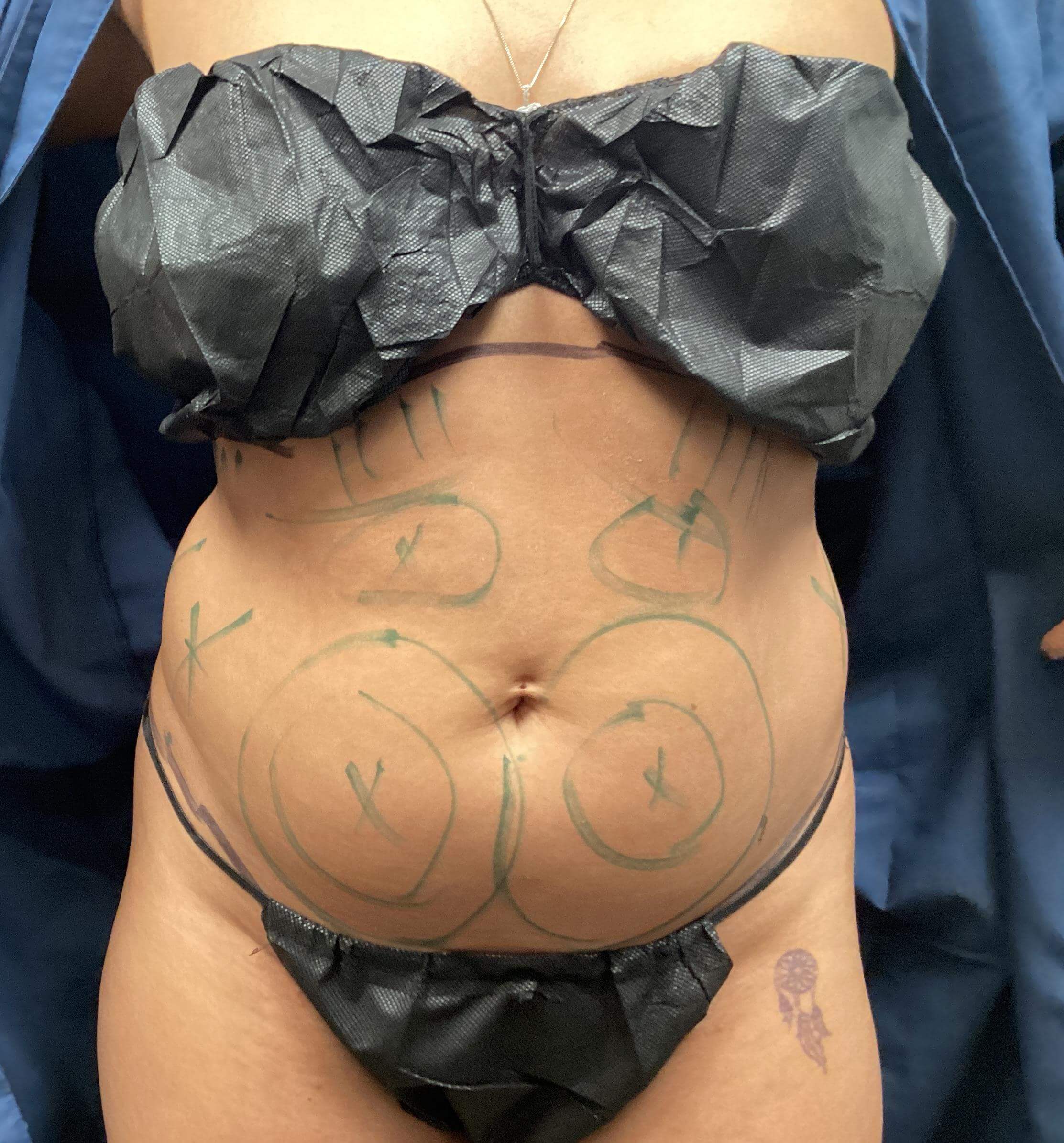
The Zone Sequence: Abdomen & Flanks
Infiltration Order
Right Lower Quadrant→Left Lower Quadrant→Left Upper Quadrant→Right Upper Quadrant→Right Flank→Left Flank
By the time the last zone is being infiltrated, the first zone has been anesthetizing for 20 or more minutes. This sequencing is deliberate - it maximizes the onset time without requiring additional waiting after infiltration is complete.
What Guests Feel During Administration
Guests are prepared in advance for exactly three sensations. Nothing surprises them during infusion.
VibrationThe instrument is turned on before it contacts the skin. Dr. Timothy Zelko places his hand on the treatment area first so guests feel the vibration through him before the cannula is introduced.
WetnessTumescent fluid leaks through the small access points as tissue swells with fluid. This is normal, expected, and a sign that infiltration is proceeding correctly.
Occasional PinchAs tumescent fluid swells the tissue, occasional mild pinching may occur. This is the extent of sensation during proper infiltration. Nothing more.
Why TickleLipo Disperses Tumescent Anesthesia More Thoroughly
The TickleLipo technology platform has a unique clinical advantage in the context of tumescent anesthesia: its inherent vibration and rotation mechanism actively disperses the tumescent fluid throughout the treatment area during infusion. Rather than relying on passive diffusion alone, the vibrational action works the anesthetic fluid more evenly through the tissue, ensuring more thorough and uniform coverage of the zones being treated.
The vibration also delivers a pain-gating response, a neurological mechanism in which vibrational stimulation activates mechanoreceptors that compete with and block pain signals traveling through the same nerve pathways. The result is an additional layer of comfort that compounds the effect of the tumescent anesthesia itself.
Early Comfort, The Cortisol Advantage
It is essential to show the guest, as early as possible, preferably within minutes, how comfortable this procedure is and will continue to be.
This is not simply a matter of patient experience. It is a clinical priority. When a guest is anxious or anticipating pain, cortisol and stress hormones elevate, driving systemic physiological responses that work against the procedure. When a guest experiences comfort early and repeatedly, that anxiety resolves. The cortisol response decreases. Tissue response improves. The guest relaxes into the procedure rather than bracing against it.
The combination of tumescent anesthesia, the TickleLipo pain-gating vibration mechanism, and the deliberate zone-by-zone sequencing is specifically designed to deliver that comfort experience within the first minutes of the procedure, and sustain it throughout. The anesthesia check that follows confirms this before any liposuction begins. By the time the first fat is removed, the guest has already experienced the full sensation of the procedure and found it completely manageable.
The Deep Mechanism
The Four-Link Cortisol Chain: What General Anesthesia Triggers
Surgery is one of the most potent activators of the human stress hormone system. General anesthesia does not prevent that activation, it masks the experience while the body still registers the surgical insult. Cortisol surges. And cortisol, sustained at four times baseline for seven days, works against every healing outcome the surgery is designed to produce.
Tumescent local anesthesia blocks that activation at the source. That distinction, between masking stress and preventing it, is the clinical foundation of this entire practice and the reason the protocol has remained unchanged across 7,000+ procedures and 17 years.
The Four-Link Chain
Link 1, HPA Axis Activation
Surgery activates the hypothalamic-pituitary-adrenal axis. The cascade: surgical stress triggers the hypothalamus to release corticotropin-releasing hormone, then the pituitary releases ACTH, then the adrenal cortex produces cortisol. General anesthesia does not block this. Local anesthesia blocks the afferent nerve signals before they reach the hypothalamus. The axis never fully activates. Cortisol stays low from the start.
Link 2, Cortisol & Post-Operative Pain
Elevated cortisol sensitizes the central nervous system, a process called central sensitization. The result: pain signals are amplified, glutamate is elevated, NMDA receptors are upregulated. Guests who recover under high-cortisol conditions experience more post-operative pain not because their procedures were more invasive, but because their nervous systems have been biochemically prepared to feel more.
Link 3, Cortisol & Infection Risk
Cortisol is immunosuppressive. It directly suppresses neutrophil and lymphocyte function at precisely the moment the surgical wound most needs immune defense. The 0.125% infection rate documented across 800+ awake tucks and thousands of TickleLipo procedures at this practice, versus the roughly 1% surgical-site infection rate published for abdominoplasty (Winocour, 2015), is the patient-side expression of this mechanism.
Link 4, Cortisol & Collagen Synthesis
Fibroblasts, the cells responsible for collagen production and scar maturation, are suppressed by cortisol. Type I and III collagen production is downregulated. TGF-β signaling is inhibited. For procedures where the final aesthetic result depends on dermal remodeling (TickleLipo), subcutaneous collagen stimulation (TickleTite), or scar quality (every excision procedure), the cortisol environment during recovery directly determines the result you actually achieve.
How Local Anesthesia Blocks the Cascade
Local anesthetic agents intercept afferent nociceptive signals before they reach the hypothalamus, shutting the HPA axis cascade off at its source rather than simply sedating the guest through it. The published result: ACTH secretion is impaired, cortisol secretion is impaired, catecholamine release is reduced. Documented additional benefits include earlier return of gut function, reduced inflammatory response to surgery, reduced pulmonary complications, and beneficial effects on the coagulation system.
“General anesthesia doesn't protect you from the stress response, it just renders you unconscious while it happens. Local anesthesia actually prevents it.”
Dr. Timothy Zelko, D.O.Sources: Bain et al., Anaesthesia, 2023 · Prete et al., Clinical Endocrinology, 2018 (systematic review, meta-analysis) · BJA Education, Anaesthesia, Analgesia, and the Surgical Stress Response · PMC Narrative Review, Regional Anesthesia and Systemic Stress Response, 2025 · Journal of Pain, Cortisol and Central Sensitization, 2015 · StatPearls: Physiology, Cortisol (NCBI, 2025).
The Protocol That Sustains It
Why the Spa Environment Has Clinical Function
The aromatherapy, music selection, partner presence, foot massage during liposuction, and facial during the tuck are not amenities offered alongside the medical procedure. They are the clinical protocol for sustaining low cortisol during a long awake procedure. The tumescent anesthesia eliminates the cortisol surge that general anesthesia triggers; the spa environment keeps cortisol low for the rest of the day. Each element is documented in the peer-reviewed literature to actively suppress pituitary-adrenal stress pathway activation.
Ativan at home, before leaving the driveway. The first oral lorazepam tablet is taken at home, not in the office. By the time the guest arrives, the anxiolytic effect is already active and cortisol is already trending down. Benzodiazepines inhibit cortisol production at the hypothalamic-pituitary level of the HPA axis, documented in both limb and abdominal surgery literature.
Guest-chosen music, active HPA suppression. Familiar, preferred music engages the mind with something comforting, competing with pain signals at the CNS level and actively suppressing the pituitary-adrenal stress pathway. This is peer-reviewed. The music is not background; it is selected by the guest and serves a documented biochemical function throughout the case. Documented effects: reduced cortisol release, lowered intraoperative sedation requirements, decreased post-op analgesic needs.
Aromatherapy, parasympathetic activation. Calming aromatic compounds activate the parasympathetic nervous system, the physiological opposite of fight-or-flight. Documented to reduce preoperative anxiety scores and salivary cortisol levels in surgical patients in controlled trials.
Partner present, isolation anxiety eliminated. A support person is present in the suite for any or all of the procedure. Isolation is a cortisol activator. Familiar presence modulates HPA axis reactivity to perceived threat. The partner is not in a waiting room; they are in the suite with the guest, present for the entire day.
Foot massage during TickleLipo, parasympathetic engagement during peak procedural stress. During the liposuction portion of every case, a foot massage is administered. Tactile physical care during a procedure actively engages the parasympathetic nervous system at the precise moment when stress activation is most likely to occur.
Facial during TickleTuck, the nervous system amplifier. Renee performs a facial during the tuck portion of every TickleTuck. The nervous system cannot simultaneously sustain high stress activation and process the calming sensory input of skilled facial work. The facial occupies the parasympathetic system during the period of peak procedural stress. This is clinical, not cosmetic.
The Reason Behind All of It
The cortisol science explains why everything works. But the reason everything exists is simpler: Dr. Zelko wants guests to have a genuinely good experience. The biochemistry is the bonus. The motivation is care, for the person on the table, not just the procedure being performed. The spa environment, the music, the foot massage, the facial, these are expressions of that. The science is what makes them defensible. The care is what makes them real.
The Non-Negotiable Standard
The Anesthesia Check: Before Any Procedure Begins
After infiltration is complete, Dr. Timothy Zelko performs an anesthesia check before removing a single drop of fat or beginning any procedure. He passes back through every zone in reverse order at the suctioning vibration rate, so guests experience exactly what the procedure will feel like before it begins.
The Standard That Does Not Move
If you feel anything - any sensation beyond vibration, at any point during the anesthesia check - we stop. We hold the cannula in place and wait.
Not anything resembling pain. Not mild discomfort. Anything. The cannula is held in place until the sensation resolves completely before moving forward. By the time the actual procedure begins, every guest has already experienced what it feels like twice, and felt nothing both times. There is no unknown. There is no surprise.
This standard does not bend for scheduling, for time pressure, or for any other reason. It is the foundation of the practice’s record.
Why Being Awake Is a Clinical Advantage
When a guest is under general anesthesia, they cannot tell you if they feel something, if an area has been missed, or if something is wrong. When a guest is awake under tumescent anesthesia, they can provide real-time feedback throughout the procedure. They can also verify in real time that every area promised at consultation is actually being treated. Dr. Timothy Zelko shows guests the results before they leave the table. General anesthesia makes none of this possible.
If you want to see what an awake procedure actually looks like, real guest, conversing throughout, an unedited TickleLipo or TickleTuck procedure video is available on our Watch the Procedure page .
Why Not General Anesthesia
The Specific Risks Tumescent Technique Eliminates
General anesthesia is not a neutral choice. It carries specific, documented risks that tumescent local anesthesia eliminates entirely. This is not a philosophical position, it is a clinical assessment that Dr. Timothy Zelko made 17 years ago and that 7,000+ procedures have confirmed.
| Risk Factor | General Anesthesia | Tumescent Local |
|---|---|---|
| Cardiac events | Present, from systemic drug effects | Eliminated |
| Respiratory depression | Present, requires airway management | Eliminated, guest breathes independently |
| Anesthesia awareness | Documented phenomenon, awareness while paralyzed | Eliminated, guest is fully conscious |
| Post-anesthesia nausea | Very common, extends recovery significantly | Eliminated |
| Hospital admission required | Required or strongly advised | In-office only, home same day |
| Anesthesiologist required | Required, adds cost and complexity | Not required, administered by Dr. Zelko |
| Procedure verification | Impossible, guest cannot confirm areas treated | Real-time, guest verifies during procedure |
The Infection Rate Connection
Zelko Aesthetics holds a documented infection rate of 0.125%, versus the roughly 1% surgical-site infection rate published for abdominoplasty (Winocour, 2015). The in-office, awake environment is a direct contributor. Hospital settings carry inherent infection risk from the environment itself. In-office tumescent procedures, performed in a clean clinical setting with a fully cooperative awake guest, eliminate a meaningful category of infection risk entirely.
Read what our guests say about being awake during their procedures on our Guest Voices page, including women whose primary fear was anesthesia and what they found when they tried tumescent local instead.
FAQs
What Guests Ask About Tumescent Anesthesia
Will I feel anything during the procedure?
After the anesthesia check confirms complete numbness, you feel only vibration during the procedure. No pain. No pinching. No discomfort. The TickleLipo vibration mechanism also delivers a pain-gating neurological response, vibrational stimulation activates mechanoreceptors that actively block pain signals, adding a layer of comfort on top of the tumescent anesthesia itself. If you wish to take the edge off anxiety before the procedure, a mild oral anxiolytic (Ativan) is available as an option, not required, but available. The anesthesia check confirms complete numbness before any liposuction begins.
Is tumescent anesthesia safe in large volumes?
Yes. The safety of tumescent technique comes specifically from the high dilution of the lidocaine. At the concentrations used in tumescent formula, large volumes can be infused with systemic lidocaine levels well below toxic thresholds. The epinephrine also slows absorption, adding an additional safety margin. Dr. Timothy Zelko has performed over 7,000 procedures using this formula without a lidocaine toxicity event.
How long does the anesthesia last after the procedure?
Tumescent anesthesia typically provides 4 to 8 hours of effective numbness after infusion. For most guests, the treatment area remains numb for several hours into the recovery period. As it wears off over the hours following the procedure, some soreness develops, which is expected and managed with over-the-counter pain relief. The extended duration is specifically due to the epinephrine, which slows absorption and extends anesthetic effect significantly.
Does the tumescent fluid need to drain after the procedure?
Yes. Tumescent fluid drains through the small access incisions for the first 24 hours post-procedure, with most drainage occurring in the first 4 to 6 hours. The drainage looks like diluted blood, a light cherry-red color from the small amount of blood mixed with the anesthetic fluid. This is expected, normal, and actually beneficial, the drainage carries residual lidocaine and debris out of the treatment area, reducing bruising and swelling. Guests are provided absorbent pads and a compression garment to manage drainage comfortably.
Why does Dr. Zelko never use general anesthesia?
The clinical case is specific: general anesthesia carries real risks of cardiac events, respiratory depression, and anesthesia awareness that tumescent technique eliminates entirely. An awake guest can verify in real time that every area promised at consultation is being treated. They can provide feedback during the procedure. They go home the same day without the prolonged recovery general anesthesia requires. After 17 years and 7,000+ procedures, there is no clinical reason to introduce those risks when tumescent technique provides complete, safe, sustained anesthesia without them.